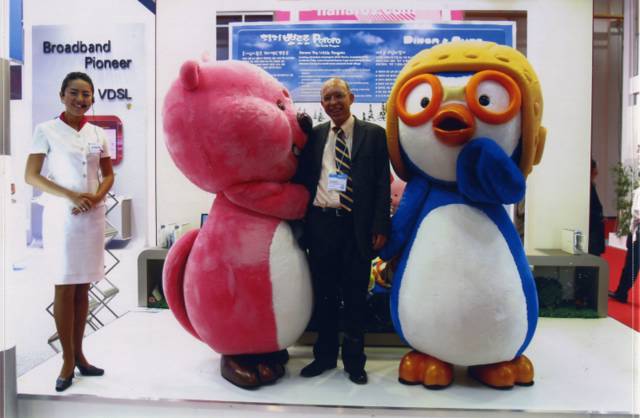
Hanaro Telecom stand, ITU Telecom Asia
Like the character Bill Murray plays in the film “Lost in Translation”, I feel a bit disoriented visiting the ITU Telecom Asia show in Busan, Republic of Korea. First of all, I am not even sure what the city is called. Some people call it Busan, others Pusan. Even my hotel seems inconsistent. The sign outside says Busan Lotte Hotel whereas the stationary in the desk calls it the Hotel Lotte Pusan.
The show is at the Busan Exposition Centre (BEXCO), anywhere from 20 minutes to one hour from the hotel depending on the traffic. Even though it is supposed to be regional, a lot of the stands have information only in Korean and a lot of the staff only speak Korean. Some of the wares seem strange—mobile phones with cartoon characters that act as your agent or a phone that recognizes your finger prints, allowing you assign different people to call to each finger—just imagine who you could assign the middle ones to. Talking about cartoon characters, one of the most popular stands was that of Hanaro Telecom—a Korean broadband operator. There was a constant line of people waiting to have their picture taken with what I think was some kind of chipmunk and a penguin; I obliged of course. At the SK Telecom stand, break dancers and rap singers attracted a constant crowd. Combined with a massive case of jet lag after a 14 hour daylight flight from Washington DC, I feel lost in all of this.
This place is rife with contradictions. Korea is the world’s broadband leader yet large parts of it remain inoperative to Westerners or even anyone non-Korean. I’ve had loads of difficulties printing documents from PCs that display only Han (the Korean alphabet). I’ve waded through Korean Power Point relying on memory to navigate menus. I end up with printouts that have elements displaced—background shows up on one slide and the foreground on another. My hotel room is the first I’ve had with a PC but the system to access the Internet is unfathomable and I had to call for help to establish a Wi-Fi connection.
I guess this is how people must feel that have had to use computers and the Internet in English for so many years. But the more I think about it, this is one reason why the Republic of Korea is so far ahead in information and communication technology. It has successfully adapted information technology to its environment so that understanding English is no longer a barrier. This is a lesson more countries need to learn if they are to successfully join the digital world.
ITU Telecom Asia, 7-11 September, Busan-Republic of Korea


